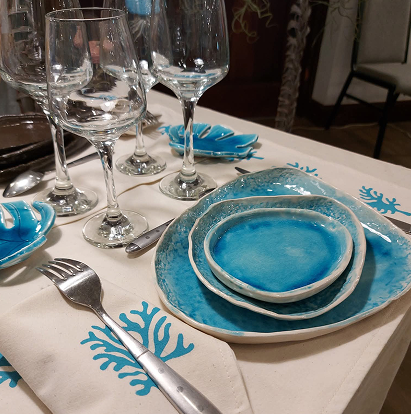
There is something special about holding a handmade ceramic object. Each piece is slightly different from all the others. Not perfect in the industrial sense of the word—and that is exactly what makes it beautiful.
To understand why, we have to go back to the beginning. To the clay.
The clay: where everything begins
Before it becomes a cup, a small dish or a bowl, a handmade ceramic piece starts as a block of raw clay.
Earthenware, stoneware, porcelain: each type of clay has its own character. Some create a more raw, dense finish, while others produce something finer, smoother, almost luminous.
But before anything can be shaped, the material has to be prepared. The clay is wedged, air bubbles are removed, and the texture is softened. This careful preparation is essential: poorly prepared clay can crack, warp or even break during firing.
Shaping: giving form by hand
This is often the stage people imagine first when they think of pottery.
Depending on the piece being made, the artisan chooses the most suitable technique. On the wheel, the clay is shaped into rounded, balanced forms: bowls, plates, vases or cups.
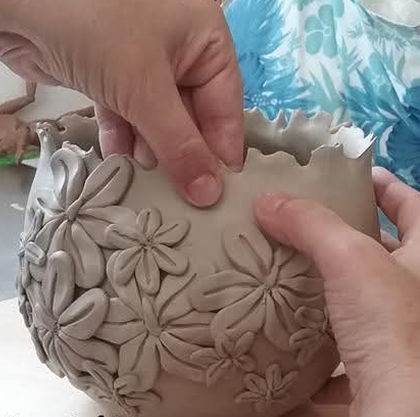
With hand-building, the hands work more freely: hollowing, pinching and adding clay, especially for sculptures and decorative objects.
Coiling is used to build up a piece gradually, with long rolls of clay layered one on top of another. Moulding, meanwhile, allows a shape to be reproduced from a mould before the finishing touches, decoration and glazing.
Little by little, the piece takes shape: the volume becomes clearer, the height emerges, the thickness is adjusted, and the rim is refined.
Drying: letting the clay dry slowly
Once shaped, the piece has to dry slowly and gradually, without rushing.
If the clay dries too quickly, it can crack or deform. The artisan watches over the process, makes adjustments and allows the moisture to evaporate little by little, sometimes over several days depending on the size of the object.
At this stage, the piece is still fragile, but it can still be refined: a rim can be thinned, a curve corrected, a detail added.
The first firing: the bisque stage
Once the piece is completely dry, it goes into the kiln for the first time.
This firing transforms it into what is known as bisque: solid, but still porous. This porosity is what allows the glaze to adhere properly in the next stage.
Glazing: where the piece finds its colour
Glaze gives the piece its colour, texture and character. On everyday objects, it also protects the surface.
Matte, glossy, satin, speckled, mineral: the possibilities are almost endless. The application technique changes depending on the desired effect — brushwork, dipping, pouring — and influences the final result as much as the glaze itself.
At this stage, the piece is ready for its final transformation: the firing that will set the glaze and reveal its nuances.
The second firing: opening the kiln
After glazing, the piece returns to the kiln. This is the final firing, the one that sets the glaze and reveals its true finish.
Under the effect of heat, the glaze melts, transforms and bonds to the surface. The artisan knows the clay, the glazes and the firing temperature. But they can never fully control how all these elements will react together.
The result is only discovered when the kiln is opened. A colour may shift, a texture may appear, a drip may reveal itself. This element of surprise is part of what gives handmade ceramics their character.
The final checks before sale
Once out of the kiln, each piece is inspected one by one. The artisan checks the glaze, the edges, any possible cracks, as well as the overall appearance of the object: its colour, texture and visual balance.
If needed, the foot of the piece is lightly sanded, a rough edge is softened, or a finish is adjusted before the piece is listed for sale.
Why no two handmade pieces are ever exactly alike
In handmade work, no two pieces are strictly identical. A curve, a glaze variation or an edge may differ slightly from one piece to another.
These differences come from the hand, the clay and the firing. They give each object its own character, far from the uniform perfection of industrial production.
In summary
From raw clay to finished object, each piece goes through several stages: preparing the material, shaping, drying, first firing, glazing, second firing, and final checks before sale.
Days of work, waiting time, precise gestures — and at the end of the process, an object unlike any other.
At Ū Matatea, every piece is handcrafted with patience, passion and care.