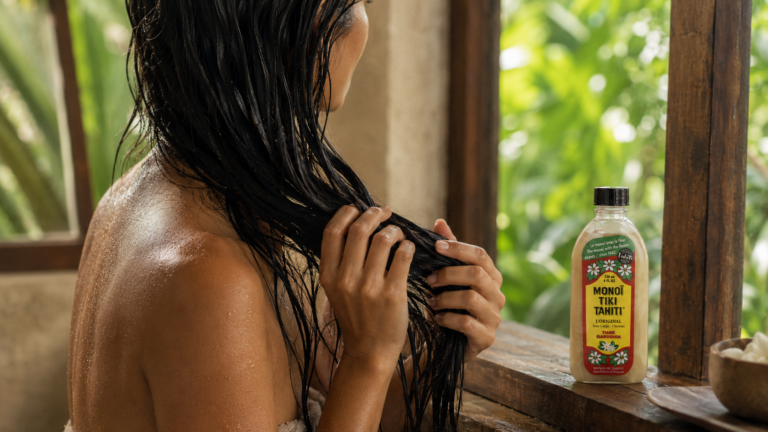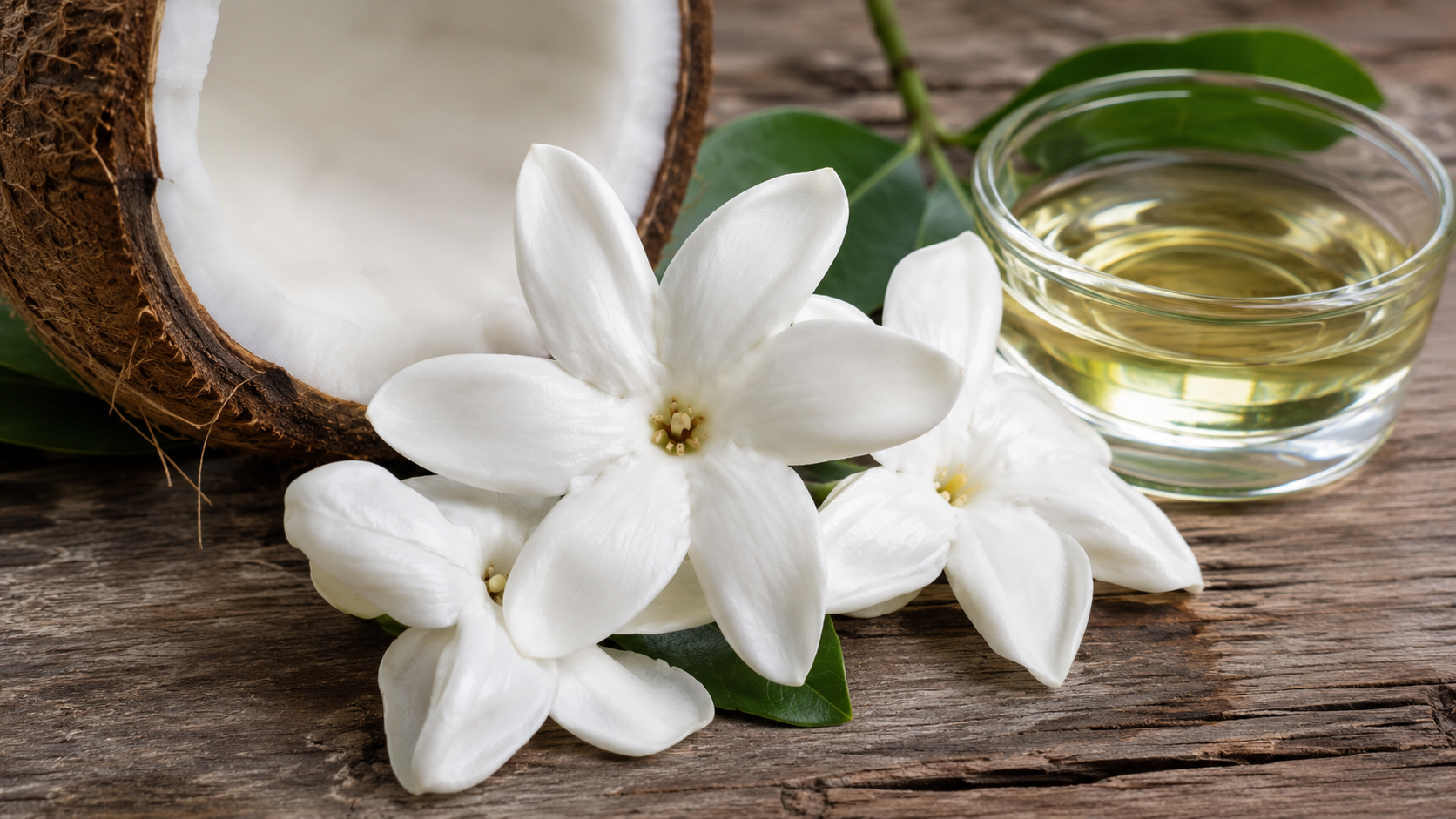
Monoi from Tahiti begins with a simple encounter: that of the coconut and the tiare flower.
On one side, copra oil, obtained from the dried flesh of the coconut. On the other, fresh tiare Tahiti flowers — white, delicate and instantly recognisable by their fragrance.
Between the two lies an essential step: maceration. This is what gives monoï its identity. The scent is not simply added to the oil: it slowly infuses through contact with the flowers, transforming coconut oil into one of French Polynesia’s most iconic care rituals.
But genuine Monoï de Tahiti is not just a scented oil. Since 1992, its name has been regulated: to be called “Monoï de Tahiti”, the product must be made in French Polynesia, according to a specific process, using refined copra oil and tiare Tahiti flowers.
Copra oil: the base of monoï
The making of monoï begins with the coconut.
To produce Monoï de Tahiti, refined copra oil is used. Copra simply refers to the white flesh of the coconut once it has been dried. From this material, a soft, stable oil is extracted, which then serves as the base for macerating the tiare flowers.
This oil gives monoï its rich, enveloping texture. It allows the product to glide over the skin, nourish dry areas, soften the hair and leave behind its recognisable satin finish.
You could say that coconut gives monoï its body. The tiare flower gives it its fragrance.
The tiare flower: a symbol of the islands
Tiare Tahiti, also known as Gardenia taitensis, is the emblematic flower of Monoï de Tahiti.
White, luminous and deeply rooted in Polynesian culture, it is not used only for its fragrance. It is worn behind the ear, in the hair, in garlands, as a gesture of welcome or during important moments.
It is often said that a flower worn on the left, close to the heart, means that the person is taken; worn on the right, it means that they are single.
In monoï, tiare brings that warm, soft and enveloping fragrance that immediately evokes the islands.
Maceration: the heart of the know-how
Fresh tiare flowers are placed in refined copra oil. Little by little, the oil absorbs their fragrance, taking on the soft, rich and satiny signature that is unique to monoï.
To comply with the “Monoï de Tahiti” appellation, the maceration must last at least ten days, with a minimum of ten tiare flowers per litre of oil. It is this time spent in contact with the flowers that distinguishes genuine monoï from a simple scented oil.
Why genuine Monoï de Tahiti is regulated
Not every product that smells of tiare is necessarily Monoï de Tahiti.
The “Monoï de Tahiti” appellation protects a specific product: an oil made in French Polynesia from refined copra oil and tiare flowers, according to a regulated process.
This is what sets genuine monoï apart from an oil that is simply scented. Beyond the fragrance, there is an origin, precise ingredients and a specific production method.
How to recognise genuine Monoï de Tahiti
To choose an authentic monoï, do not rely on fragrance alone. There are two main things to check:
The words “Monoï de Tahiti”
This indicates that the product is linked to a regulated appellation and to a specific production process in French Polynesia.
The INCI ingredients list
In the ingredients list, look in particular for Cocos nucifera, for coconut oil, and Gardenia taitensis, for the tiare Tahiti flower.
Terms such as “monoï scent”, “tiare fragrance” or “exotic oil” can be misleading. They evoke the world of monoï, but they do not guarantee on their own that the product is genuine Monoï de Tahiti.
In other words, an oil that smells of tiare is not necessarily Monoï de Tahiti. To check, look at the wording on the bottle and the product’s ingredients list.
In short: how is Tahitian monoï made?
Authentic Tahitian monoï is made from refined coconut oil and fresh Tahitian tiare flowers.
The flowers are left to infuse in the oil for at least ten days, using a minimum of ten flowers per litre. This traditional infusion process gives monoï its distinctive fragrance, softness and character.
To recognise an authentic product, look for the words “Monoï de Tahiti”, check its Polynesian origin and make sure Cocos nucifera and Gardenia taitensis are listed among the ingredients.
Discover Tahitian monoï
Tahitian monoï is much more than a simple scented oil: it is the result of Polynesian know-how passed down from generation to generation.
To choose an authentic monoï, pay close attention to its origin and composition. Look for the words “Monoï de Tahiti” and check in particular for Cocos nucifera and Gardenia taitensis, the two ingredients at the heart of its traditional preparation.
At Ū Matatea, we carefully select authentic Tahitian monoï with the same attention to quality that we bring to every creation and product featured in our boutique.