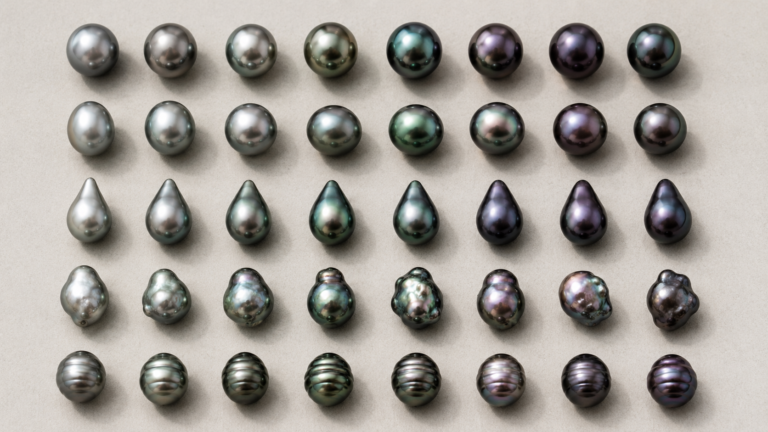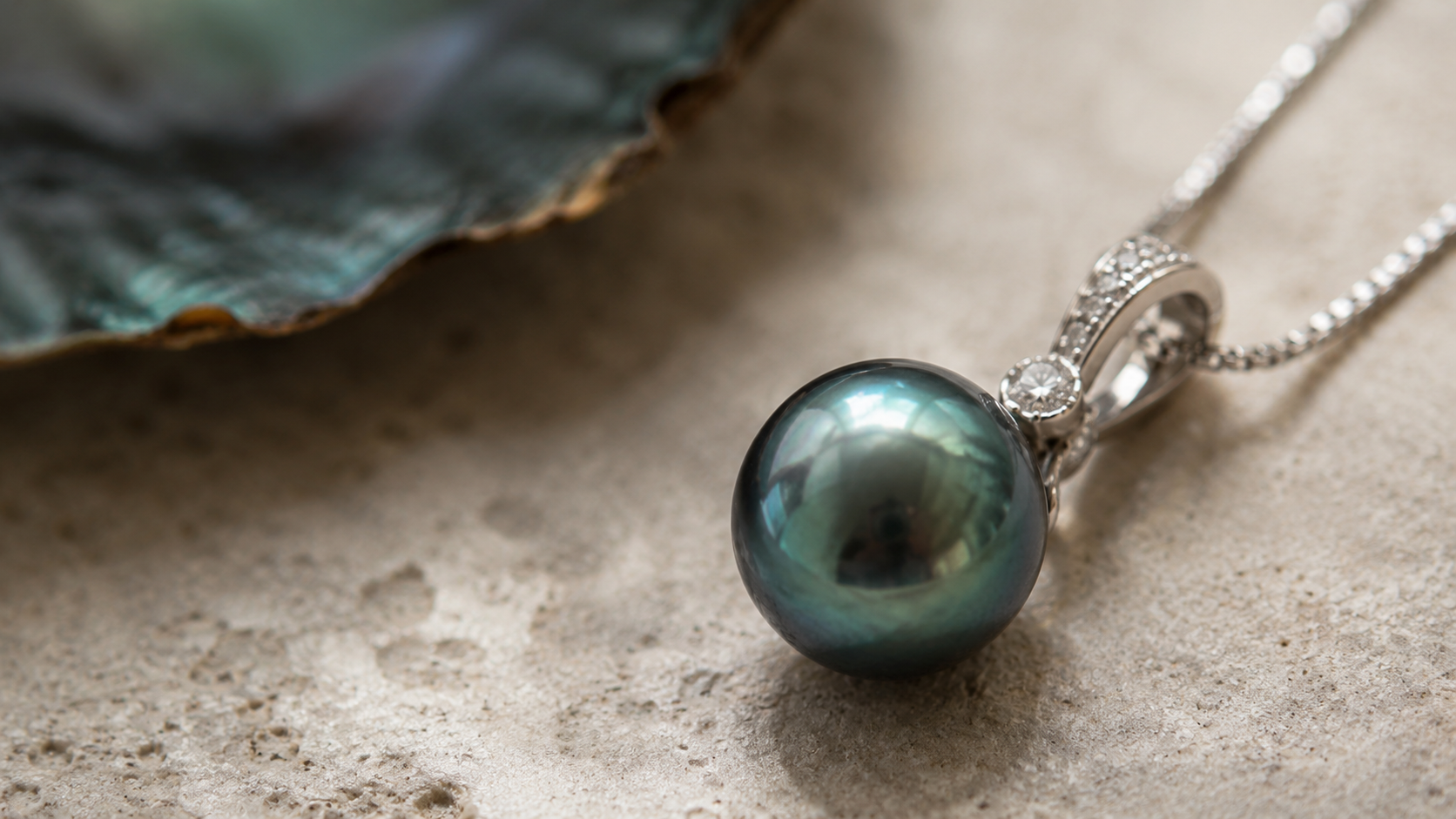
A black pearl is not necessarily a Tahitian pearl.
This is one of the most common misconceptions. A pearl can be dark and shiny without coming from French Polynesia: it may be dyed, artificial, or sold under a name that creates confusion. Conversely, a genuine Tahitian pearl is not always black. Depending on its reflections, it may appear silver-grey, peacock green, aubergine, bluish, bronze or very light in tone.
To recognise one properly, you need to look beyond colour alone: its origin, its exact nature, its visual appearance, and how the jewellery is described.
Origin: the first key indicator
A genuine Tahitian pearl is a cultured pearl produced in French Polynesia, formed by the Pinctada margaritifera pearl oyster, also known as the black-lipped oyster.
This oyster is what gives Tahitian pearls their naturally dark shades and distinctive reflections. A reliable product page should therefore clearly state that the pearl is a Tahitian cultured pearl, with Polynesian origin.
Wording such as “black pearl”, “Tahitian style”, “Tahiti-style”, “Polynesian-inspired” or “dyed pearl” is not enough. These terms may evoke the world of Tahitian pearls, but they do not guarantee authenticity.
What you can observe on the pearl
The eye can give useful clues, especially when looking at the pearl as a whole.
A genuine Tahitian pearl often has nuanced reflections. Depending on the light and angle, a grey tone may shift towards silver, a green towards peacock, or a dark shade towards aubergine, blue or bronze. If the colour looks very even, almost too uniform, it is worth checking what the product description says.
Lustre is also very important. It refers to the way the pearl catches the light. A beautiful lustre gives depth and presence to the piece of jewellery. However, a very uniform, almost varnished shine should raise questions: it may suggest an imitation or a treated pearl, especially if the pearl’s origin is not clearly stated.
Finally, a genuine pearl may have small natural irregularities, as it forms inside an oyster. This does not mean it has to be visibly marked: some authentic pearls are very regular. What matters is the overall impression: the reflections, lustre, surface, setting and consistency with the description.
Price: a useful clue, but not enough on its own
Price can give an indication, but it is not enough to judge a pearl.
A genuine Tahitian pearl requires time, expertise, selection and a quality setting. Its price varies depending on its size, shape, lustre, colour, surface quality and the metal used.
An accessible price is not necessarily suspicious: some authentic pearls are more affordable depending on their size, shape or surface. What should attract attention is a very low price with no precise information about the pearl’s origin, size or the metal used in the jewellery.
Information to check before buying
To buy with confidence, a product page should provide clear, concrete information, including:
- the pearl’s origin;
- its nature: Tahitian cultured pearl;
- its size in millimetres;
- its shape;
- its colour or reflections;
- the metal used in the jewellery.
The clearer this information is, the easier it is to understand what you are buying. A genuine Tahitian pearl should not be presented simply as a pretty “black” or “exotic” piece of jewellery: it should be properly described.
The certificate: useful, but not always mandatory
A certificate can be reassuring, especially for a high-value pearl or a fine jewellery piece.
However, not all Tahitian pearl jewellery comes with an individual certificate, particularly when it comes to more accessible pieces or jewellery made in small series.
The absence of a certificate does not automatically mean that the pearl is fake. For more accessible jewellery, what matters most is that the basic information is clearly provided: the pearl’s origin, size, shape, reflections and the metal used.
The tooth test: best avoided
You may sometimes read that rubbing a pearl against your teeth is enough to tell whether it is real. A genuine pearl is said to feel slightly grainy, while an imitation would feel smoother.
In practice, this test is limited. It may help identify some very basic imitations, but it cannot tell you whether a pearl is truly a Tahitian pearl. It is also unhygienic and not suitable for a delicate piece of jewellery.
It is better to rely on verifiable information rather than a home test.
In summary: the right things to look for
To recognise a genuine Tahitian pearl, the best indicators are:
- a clearly stated origin: French Polynesia;
- the words “Tahitian cultured pearl”;
- a precise description of the size, shape and reflections;
- reliable photos;
- a price consistent with the stated quality;
- a transparent seller.
A genuine Tahitian pearl is recognised not only by its beauty, but also by the information that comes with it. The clearer the description, the easier it is to choose a piece of jewellery with confidence.
To discover carefully selected Tahitian pearl jewellery, explore our collection in the Ū Matatea shop.