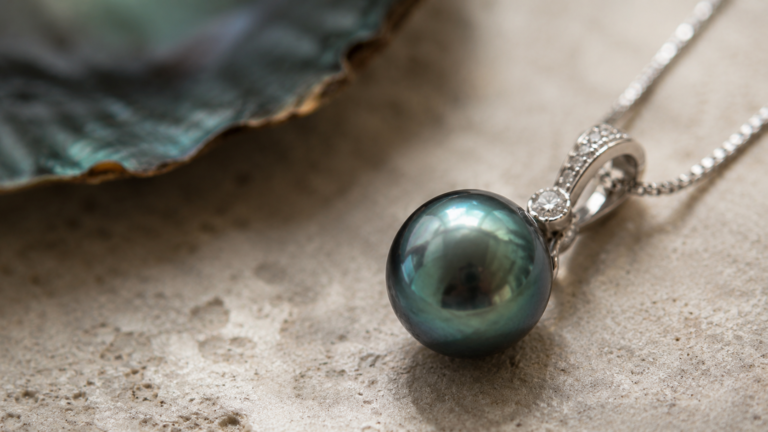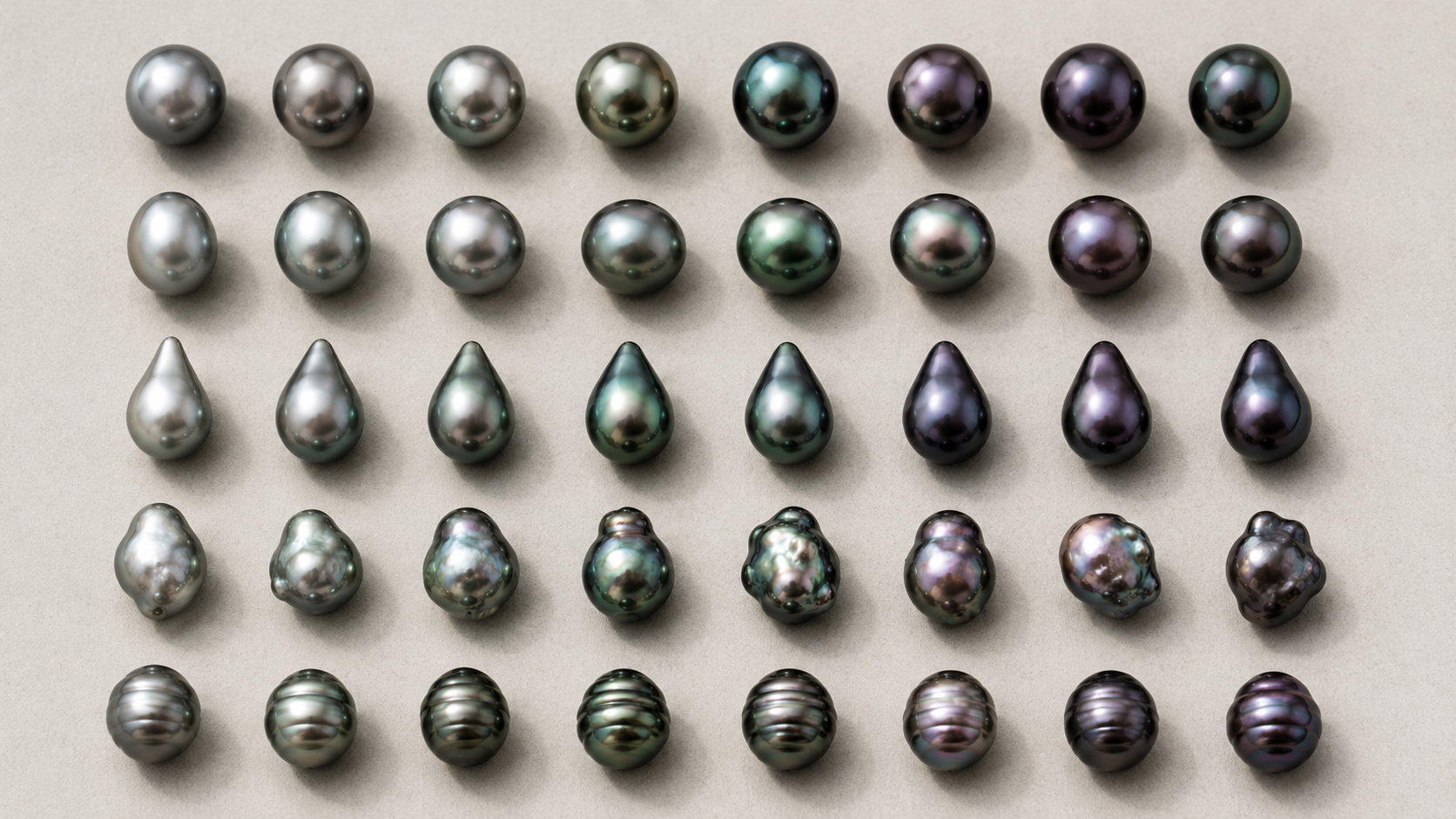
There is no single type of Tahitian pearl.
There are round pearls, baroque pearls, circled pearls, darker pearls, lighter pearls, and pearls with shades of green, aubergine, grey, blue or bronze. Some appear almost perfect. Others have small irregularities that make them unique.
That may be what makes Tahitian pearls so beautiful: no two are truly alike. Each one reveals its own shape, depth and distinctive reflection.
To choose the right Tahitian pearl, you need to look at its shape, colour, lustre, surface and size. These criteria influence its value, but also the way it looks once set in jewellery: classic, luminous, discreet or more distinctive.
The Tahitian pearl: a cultured pearl born in the lagoons
The Tahitian pearl is a cultured pearl produced in French Polynesia, mainly from the Pinctada margaritifera pearl oyster. It is known for its naturally dark colours, although the term “black pearl” is often too restrictive: its shades can range from silver-grey to peacock green, with aubergine, blue, bronze or chocolate tones.
Unlike an imitation, a cultured pearl genuinely forms inside an oyster. Human intervention consists of inserting a nucleus, after which the oyster gradually deposits layers of nacre around it. This process requires time, patience and precise expertise. It is also why each pearl is different, even when it comes from the same pearl farm.
In French Polynesia, the production and sale of pearl products are regulated. This framework helps distinguish genuine Tahitian pearls from imitations, dyed pearls or vague, misleading names.
A beautiful Tahitian pearl is therefore not defined by colour alone. Its shape, radiance, surface regularity, size and depth of reflection also play an essential role. It is the balance between these criteria that determines its quality.
The shapes of Tahitian pearls
Tahitian pearls can come in several shapes. The best known are:
- round pearls, highly sought after for their regularity;
- semi-round pearls, slightly less perfect but very harmonious;
- oval pearls, soft and elegant;
- button pearls, flatter in shape and often used for earrings or rings;
- drop or pear-shaped pearls, especially popular for pendants;
- baroque pearls, irregular, expressive and often very distinctive;
- circled pearls, recognisable by the natural rings around their surface.
Round shapes are often the most classic. Baroque and circled pearls, on the other hand, bring more character. They are ideal for more distinctive jewellery, where a less regular and more expressive shape is desired.
The colours of Tahitian pearls
People often speak of the “black Tahitian pearl”. In reality, its colours are much more varied than many imagine.
A Tahitian pearl can be silver-grey, peacock green, aubergine, bluish, golden, bronze, chocolate, or display several reflections at once. Its colour depends on many natural factors, including the oyster, its environment and the farming conditions.
This is also why it is difficult to find two perfectly identical pearls. Even when they are matched, they often keep a shade, depth or reflection of their own.
Lustre: what gives the pearl life
Lustre refers to the pearl’s glow and the way it reflects light. The more intense the lustre, the deeper and more alive the pearl appears. Conversely, a pearl with weak lustre will look flatter and less luminous.
A smaller pearl with a beautiful glow can therefore have more presence than a larger pearl with a duller finish.
It is one of the most important criteria for assessing the quality of a Tahitian pearl, alongside surface, shape, colour and size.
Surface: understanding natural irregularities
A Tahitian pearl forms inside an oyster over time. Its surface may therefore show small natural marks: dots, slight roughness or irregularities.
A perfectly smooth surface is rare and highly sought after. But a pearl with a few imperfections can still be very beautiful if its lustre is strong, its colour harmonious and its shape well balanced.
The important thing is to look at the pearl as a whole. A small mark does not necessarily reduce its charm: it all depends on where it is and how visible it is.
Size: a question of balance
The size of a Tahitian pearl is measured in millimetres. The most common diameters are often around 8 to 14 mm, while larger pearls, over 15 mm, are rarer and more sought after.
A large pearl naturally draws the eye. It gives presence to a pendant, a ring or a more striking piece. A smaller pearl, on the other hand, can be more discreet, lighter and often easier to wear every day.
But size is not everything. A more modest pearl with beautiful lustre and a deep colour can be more harmonious than a larger pearl with less glow. The right choice therefore depends on the piece of jewellery, the desired style and how you want to wear it.
Which Tahitian pearl should you choose?
For a classic, timeless piece of jewellery, a round or semi-round pearl is often preferred, with beautiful lustre and a regular surface. It is an ideal choice for an elegant pendant, a simple ring or easy-to-wear earrings.
For a more distinctive piece, a baroque or circled pearl can be a beautiful choice. Its irregularities, rings or more organic shape bring character and make each piece truly unique.
Colour also plays an important role in the choice. A soft grey or silver tone will create a discreet, easy-to-wear piece. A peacock green, aubergine shade, blue reflection or bronze tone will bring more character. And if you are hesitating between two pearls, look at the one that catches the light best: it is often the one that will have the most presence when worn.
Choosing a Tahitian pearl does not necessarily mean looking for the most perfect pearl. It means finding the one whose shape, colour, glow and style best match the piece of jewellery you want to wear.
In summary
The main criteria for choosing a Tahitian pearl are:
- shape;
- colour;
- lustre;
- surface regularity;
- size;
- harmony with the piece of jewellery.
Beyond the technical criteria, the most important thing is the final result: a harmonious piece of jewellery that is pleasant to wear and true to what you are looking for.
To discover carefully selected Tahitian pearl jewellery, explore our collection in the Ū Matatea shop.